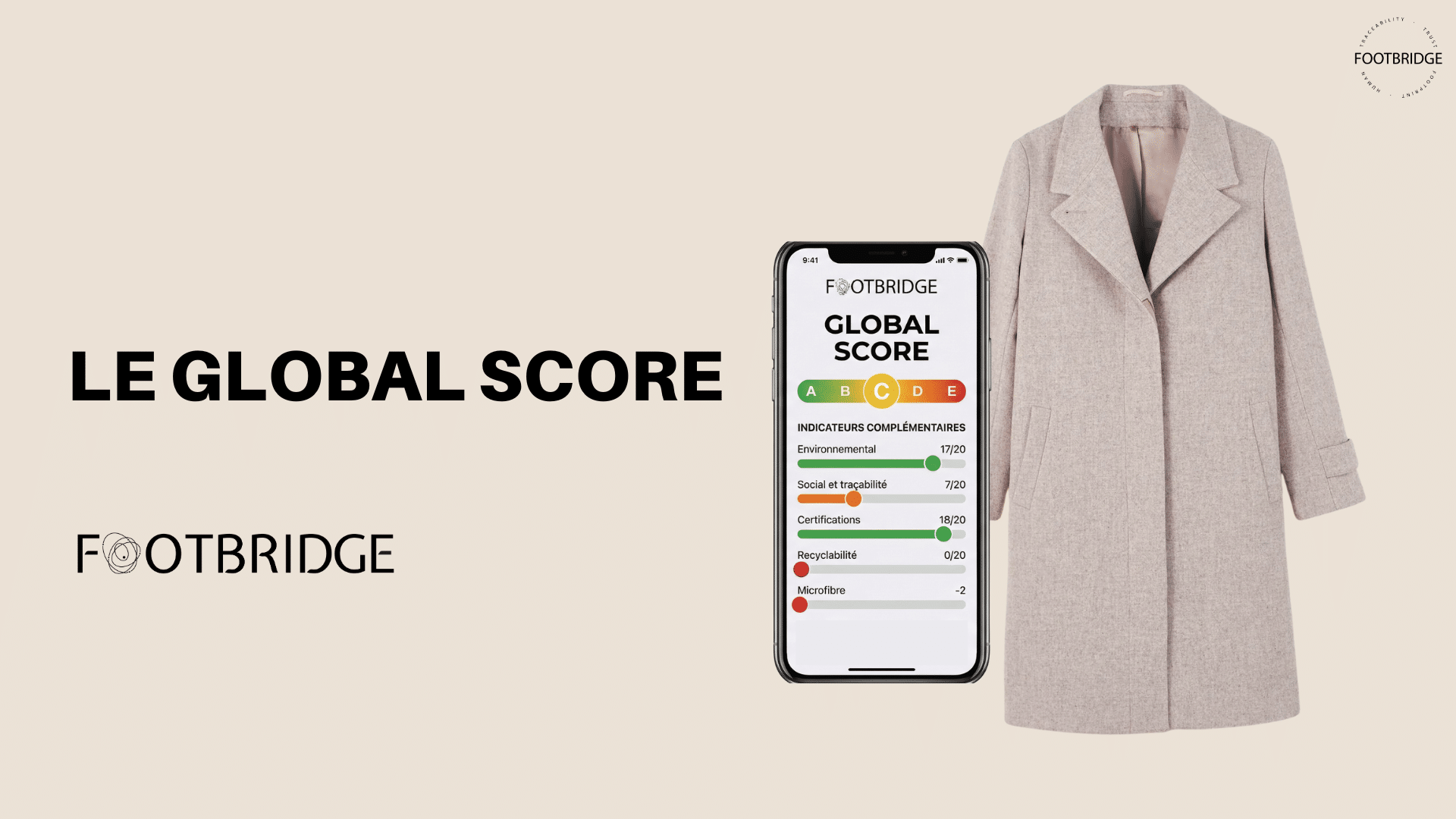
In a sector under growing regulatory pressure, product and CSR teams need reliable, legible, and actionable management tools. Building on 20 years of expertise in textile eco-design, Footbridge has developed the Global Score: a unique indicator, rated from A to E, that aggregates the environmental, social, traceability, and recyclability dimensions of a product. A tool designed not to replace the regulatory environmental score, but to complement it and give it meaning.
Sommaire
1. Why a Global Indicator Beyond the Environmental Cost?
A regulatory context accelerating rapidly
Since the Grenelle de l’Environnement (2009), textile regulation on environmental impact has gradually taken shape. Several major milestones now mark the agenda for brands:
- 2013: launch of the Product Environmental Footprint (PEF) by the EU
- 2022: completion of the Xtex project (ADEME) for a textile environmental score
- 2025: entry into force of mandatory environmental labelling in France
- 2026: generalisation of environmental cost communication
- 2027: rollout of the European Digital Product Passport (DPP)
Footbridge, an actor involved in developing the French regulatory environmental cost, anticipated this trajectory. The Global Score allows brands to anticipate the DPP requirements today, by incorporating the dimensions it will impose tomorrow.
The limits of the environmental cost alone
The regulatory environmental cost is a genuine step forward that Footbridge fully supports. It rests on an aggregation of 16 impact factors and is expressed in points — an abstract unit that is difficult to interpret without a reference. Three concrete limitations arise for product teams:
- No clear comparative benchmark (am I performing well or poorly, relative to what?)
- An LCA database that is still incomplete for certain product typologies
- An exclusively environmental reading, with no social dimension or traceability
The Global Score addresses precisely these gaps by adding a layer of legibility, comparison, and comprehensiveness that the regulatory cost does not provide.
2. How Does the Global Score Work?
The Global Score is calculated automatically by the Footbridge SaaS platform from real supply chain data. It is based on four weighted criteria and a bonus/penalty mechanism:
30% — Environmental impact (LCA)
The product’s LCA score is compared to that of a reference product representative of the market for the same category. This benchmark is built on a statistically robust sample (95% confidence level, ±5% margin of error), covering the full market spectrum — from ultra fast-fashion to luxury. This relative approach enables an immediately understandable reading: am I better or worse than the market average?
30% — Social impact and traceability
This pillar rewards brands that have implemented real, verifiable, and auditable traceability of their supply chain. The criteria assessed cover: the country of manufacture at each stage, the named identification of suppliers, the existence of a code of ethics, and the conduct of recognised social audits (SA8000, WRAP, ISO 26000, ICS…). Every declared data point must be documented and auditable. The further a brand can trace back into its value chain, the higher its score.
30% — Rate of certified materials
The percentage of certified materials in the product’s composition is measured, whether certifications apply to raw materials or finished products. Among the recognised labels: GOTS, Global Recycled Standard (GRS), Recycled Blend Standard (RBS), RWS (Responsible Wool Standard), OEKO-TEX, and others.
10% — Product recyclability
Products made from a single material or with a simple composition are rewarded, as they facilitate sorting and recycling at end of life. A 100% wool jumper will thus score higher than a cotton/polyester/elastane blend.
Bonus/penalty — Microfibre impact
A microfibre score, calculated using the official ADEME methodology, is added to or subtracted from the final rating depending on the nature of the fibres. Synthetic materials that release plastic microfibres during washing are subject to a penalty.
Calculate the eco-score of your clothing
Master the environmental impacts of your designs with our dedicated platform.
Schedule a demo3. A Concrete Example: an RWS Jumper Rated B
To illustrate the logic of the Global Score, let us take a 100% wool pullover with full traceability: RWS-certified farming in Australia, spinning and dyeing in China, knitting and assembly in Italy.
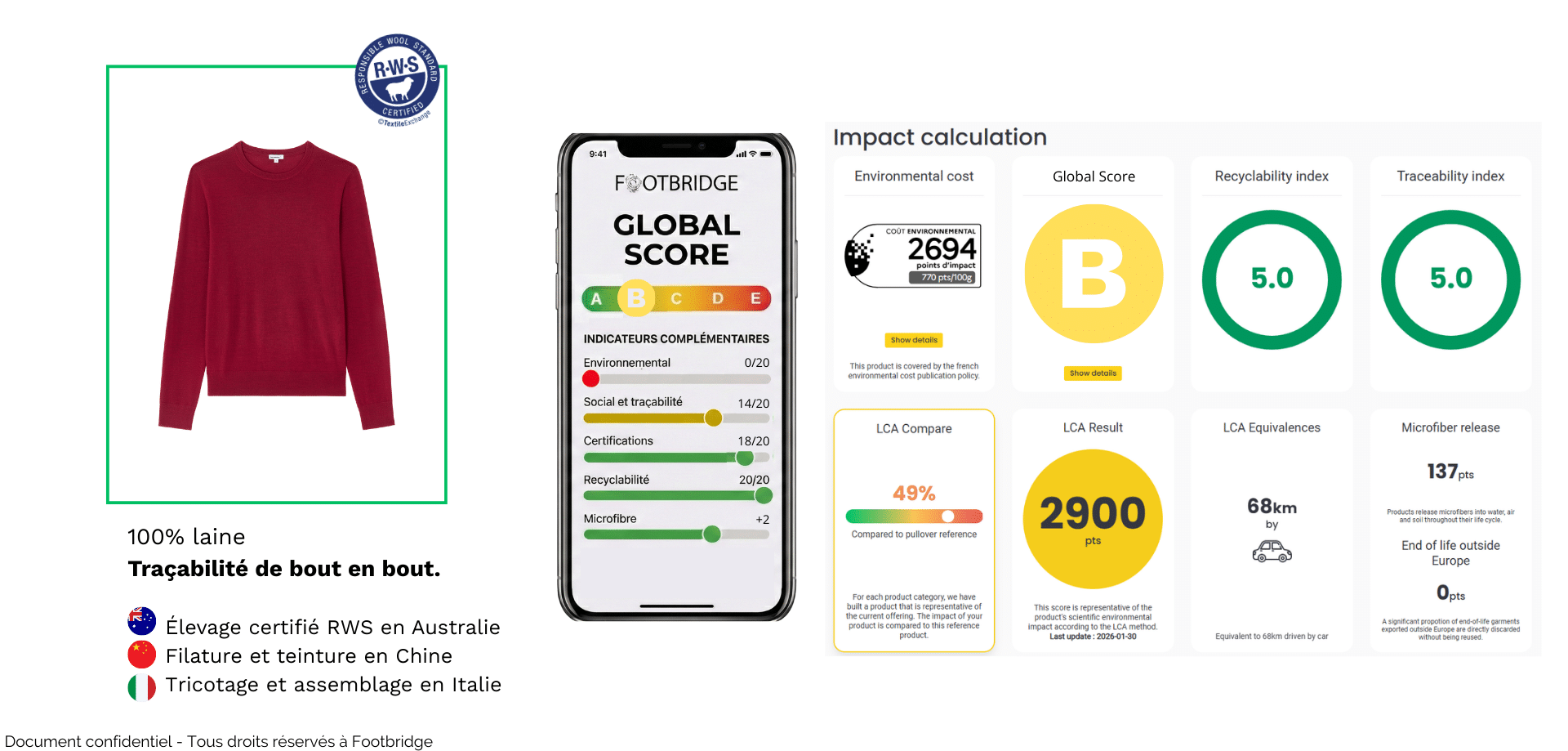
- Environmental impact: 0/20 — LCA cost 49% higher than the reference product (wool is a high-carbon fibre)
- Social impact and traceability: 14/20 — end-to-end identified chain with audits
- Certified materials: 18/20 — recognised RWS certification
- Recyclability: 20/20 — single material, 100% wool
- Microfibres: +2 — natural fibres, no microplastic release
- Global Score: B
This example illustrates an important reality: a product with a high raw environmental impact can achieve a good overall score thanks to its social commitments, its traceability, and its certifications. That is precisely the objective: not to reduce performance to a single dimension, but to offer a complete view of the real efforts made by the brand.
4. The Global Score: an Integrated Management Tool
The Global Score is not a standalone indicator. It is part of the Footbridge SaaS platform, which combines three complementary modules:
- Traceability at manufacturing order level: supplier onboarding, collection of auditable data, automated campaigns
- Impact measurement: Level 2 LCA calculation (including leather), integration of traceability data, 16 impact indicators
- Collection CSR dashboards: sourcing analysis, eco-design KPIs, Scope 3 carbon footprint, comparison of environmental costs
This integration ensures that the Global Score reflects real and verifiable data, rather than unverified declarations — making it a reliable tool for both internal teams and external communication.
5. What the Global Score Is Not
In the interest of clarity, a few points should be made explicit:
- The Global Score does not replace the regulatory environmental cost: when displayed in Footbridge mobile applications, the regulatory score is always communicated alongside it.
- It is not a label or a certification: it is an internal management and communication indicator, based on the brand’s own data.
- The detailed methodology is not published in full for confidentiality reasons, but the Footbridge team is available to present and explain the method to any interested brand.
Conclusion: Anticipate Tomorrow’s Obligations Today
At a time when environmental labelling is becoming mandatory in France and the Digital Product Passport is on the horizon for 2027, the brands that have structured their traceability and eco-design today will be ahead of their competitors.
The Footbridge Global Score offers a serious methodological framework, rooted in 20 years of field expertise, to measure, manage, and communicate the real impact of your collections. Not as a communications exercise, but as a genuine tool for progress.
Would you like to calculate the Global Score for your products? Schedule a demo at footbridge-impact.com.