Many fashion brands have launched sincere CSR initiatives. They have mapped their suppliers, calculated various carbon footprints, and promoted certified materials. Yet when it comes to acting decisively — reducing product impact, meeting environmental labelling requirements, preparing the Digital Product Passport — they always run into the same obstacle: traceability data on one side, impact calculations on the other, and no bridge between the two.
This is precisely the structural problem that Footbridge solves. Developed by Good Fabric, pioneers of sustainable fashion for over 20 years, the platform is the only solution on the market to unify operational traceability and environmental impact measurement in a single SaaS environment. This article explains why this unification is not merely a technical convenience — it is the prerequisite for an ambitious CSR strategy.
Sommaire
1. Traceability: A Structural Project That Only Has Value If Its Data Can Be Used
A traceability project is much more than a supplier list
Implementing traceability across a textile supply chain is an ambitious undertaking. It requires identifying every link in the chain — from the raw material producer to the manufacturing atelier — engaging each supplier in a data-collection process, and keeping that data up to date collection after collection.
This work is costly in time and resources. To be worthwhile, the data collected must serve a concrete purpose: meeting regulatory obligations (AGEC, environmental labelling, DPP), identifying social and environmental risks in the supply chain, and — crucially — feeding impact calculations.
A traceability data point that is not used in an impact calculation is an investment only half recovered.
Auditable data: the only kind that counts
In a regulatory environment where the DGCCRF can audit the supporting evidence behind environmental cost calculations, where B2B buyers demand tangible proof of commitment, and where consumers are increasingly wary of greenwashing, data quality has become a strategic issue.
Auditable data is data linked to verifiable supporting documents: supplier certificates, social audits, material composition declarations, etc. It is data that can be submitted to a third party without risk. In Footbridge, every supplier identified in the chain is associated with such evidence, collected automatically during traceability campaigns and stored in a structured way:
- Country and name of each actor at every manufacturing stage
- Code of ethics and social audit results
- Material certifications (GOTS, RWS, GRS, OEKO-TEX…)
- Regulatory compliance documents (AGEC, REACH…)
It is this data quality that then makes the next step possible: level 2 LCA calculation.
2. From Auditable Data to Level 2 LCA: The Decisive Qualitative Leap
Level 1 vs Level 2: a fundamental difference
A Life Cycle Assessment (LCA) of a garment can be performed at two levels of precision:
- Level 1 LCA (generic data):
The calculation uses average data from public databases (Ecobalyse, PEF). It provides an estimate of environmental impact, but does not reflect the specific choices of the brand. Two brands with the same organic cotton t-shirt obtain the same score, even if one sources from a GOTS-certified supplier in India and the other from a non-certified supply chain in China.
- Level 2 LCA (specific data):
The calculation integrates real data: the country of each manufacturing stage, the processes used, the local energy mix, transport distances, and actual certifications. The result is precise, differentiating, and defensible before any auditor.
Without real traceability, no Level 2 LCA is possible. Without Level 2 LCA, no reliable impact measurement. Without reliable measurement, no effective eco-design.
Why two separate tools do not work
Many brands attempt to meet these requirements with two distinct tools: a traceability tool on one side, an impact calculation tool on the other. This siloed approach inevitably generates friction:
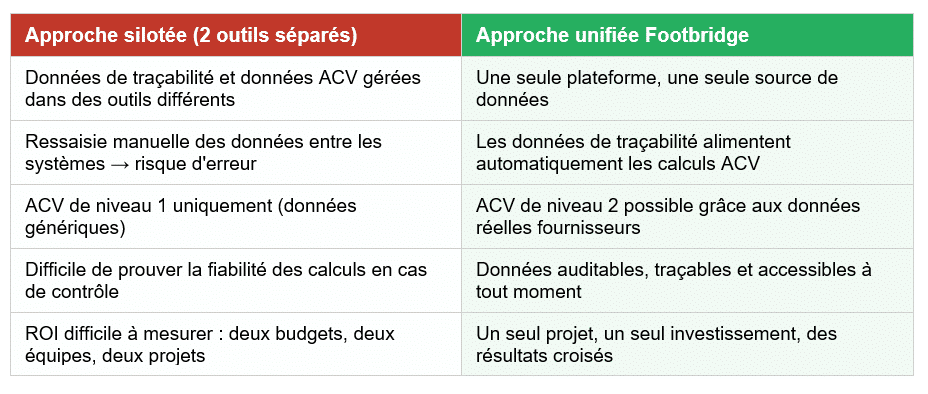 Footbridge’s unification of the two eliminates all of these friction points. The data collected during traceability campaigns feeds directly into LCA calculations — without re-entry, without interpretation, without loss of information.
Calculate the eco-score of your clothing
Master the environmental impacts of your designs with our dedicated platform.
Schedule a demo3. Measuring the Precise Impact of Each Product: A Three-Dimensional Lever
Dimension 1 — Eco-design: act on what you truly measure
Eco-design cannot be decreed. It requires the ability to answer very concrete questions at the time of designing a collection: what impact will this material change have? Is it more efficient to source this fabric in Europe or to use certified organic cotton produced in Asia? What share of the impact is related to spinning, dyeing, or manufacturing?
These questions can only be answered precisely if the LCA is performed at Level 2, with real traceability data. Footbridge’s eco-design dashboards allow product teams to simulate the impact of different material or supplier choices before production is launched, and to compare results across collections:
- Identification of the most impactful manufacturing stages
- Simulation of eco-design scenarios (change of material, country, or process)
- Progress tracking collection after collection through dedicated KPIs
Dimension 2 — CSR strategy: data to steer, not merely declare
A credible CSR strategy rests on measurable and verifiable data. The CSRD, which applies to an ever-growing number of companies, requires detailed sustainability reporting including Scope 3 — that is, precisely the emissions linked to product manufacturing. Without accurate product data, this reporting can only be declarative, and therefore unreliable.
Footbridge makes it possible to consolidate, at the level of an entire collection, the indicators needed for CSR reporting:
- Scope 3 carbon footprint by collection
- Sourcing analysis and country-by-country risk mapping
- Rate of certified materials and evolution over time
- Comparison of environmental costs across collections
CSR is not a communications topic. It is a transformation project that is steered with data. Footbridge provides that data.
Dimension 3 — Consumer engagement: communicating accurately to convince
According to a BPI France study (2025), 92% of consumers feel they are insufficiently informed about the environmental and social impact of the products they purchase. The demand for transparency is real. But it imposes a requirement: communicating in a way that is accurate, verifiable, and understandable — or risk falling into greenwashing.
The Global Score developed by Footbridge addresses precisely this need. By synthesising environmental impact, social performance, material certifications, and recyclability into a single A-to-E rating, it makes information accessible without distorting it. Displayed via the Footbridge mobile application at the point of sale or on the product sheet, it becomes a genuine differentiation tool for brands that are genuinely committed:
- A-to-E rating immediately legible to any consumer
- Detail of complementary indicators available in one click
- Compliance with the French environmental labelling framework (mandatory environmental cost included)
- Anticipation of Digital Product Passport (DPP) requirements from 2027 onwards
4. Footbridge + Good Fabric: An Offering With No Equivalent on the Market
A platform designed for textiles, end to end
There are generic traceability tools. There are LCA calculators. There are CSR agencies. Footbridge is the only solution to have integrated all of these into an ecosystem designed specifically for the fashion, textile, footwear, and leather goods sectors.
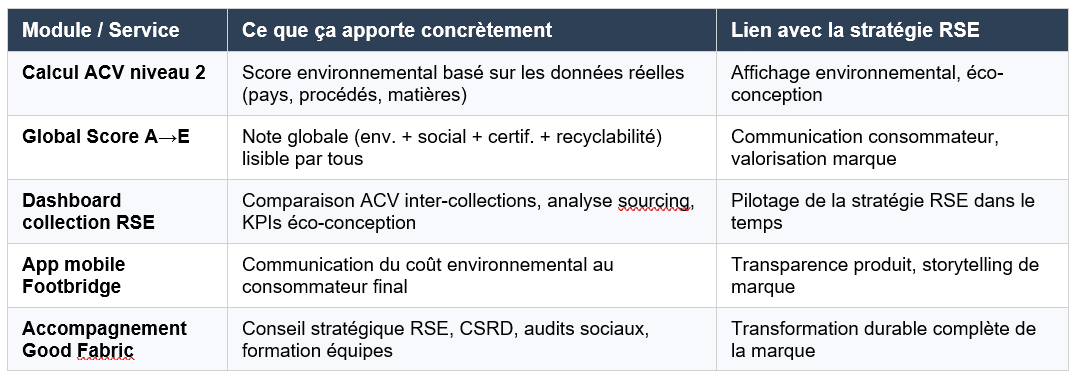
The added value of Good Fabric advisory
The platform is powerful. But a successful CSR transformation is not reducible to a tool. The Good Fabric team — pioneers of committed fashion in France for over 20 years — supports its clients at every stage:
- Definition of CSR strategy and impact reduction objectives
- Operational support for implementing traceability (supplier onboarding, campaign management)
- Advice on certification choices and social audits
- Training of internal teams (purchasing, design, product development)
- Support with CSRD and sustainability reporting
- Eco-design: special LCAs for complex products (leather, leather goods, footwear)
It is the combination of the tool and human expertise that makes results possible. The brands that chose Footbridge were not simply looking for software. They were looking for a partner capable of supporting them over the long term.
Footbridge is not just another platform. It is the CSR infrastructure of fashion brands that have decided to move from intentions to results.
Conclusion: Unification, the Non-Negotiable Condition for CSR Performance
The question is no longer whether a serious CSR approach is necessary. Regulatory obligations — environmental labelling, CSRD, Digital Product Passport — make it unavoidable. The real question is: with which tool, and with which method?
A fragmented approach — a traceability tool here, an LCA calculator there, a CSR agency elsewhere — produces incompatible data, parallel projects that never connect, and results that remain declarative.
Footbridge’s unified approach produces the opposite: traceability data that feeds precise LCA calculations, LCA calculations that inform eco-design decisions, eco-design decisions that translate into measurable and communicable progress.
It is this virtuous loop — trace, measure, improve, communicate — that Footbridge makes possible. And it is what the Good Fabric team supports, collection after collection.
Would you like to unify the traceability and impact calculation of your collections? Contact the Footbridge team for a demonstration: footbridge-impact.com